
Integrating your online store with your ERP
An integration between your online store and your ERP keeps products, prices, stock, orders and customer data updated automatically in both systems. No double entry, and your store always shows what is actually in stock.
- Ready-made integrations with more than 30 ERP, accounting and POS systems
- For WooCommerce, Shopify and Litium
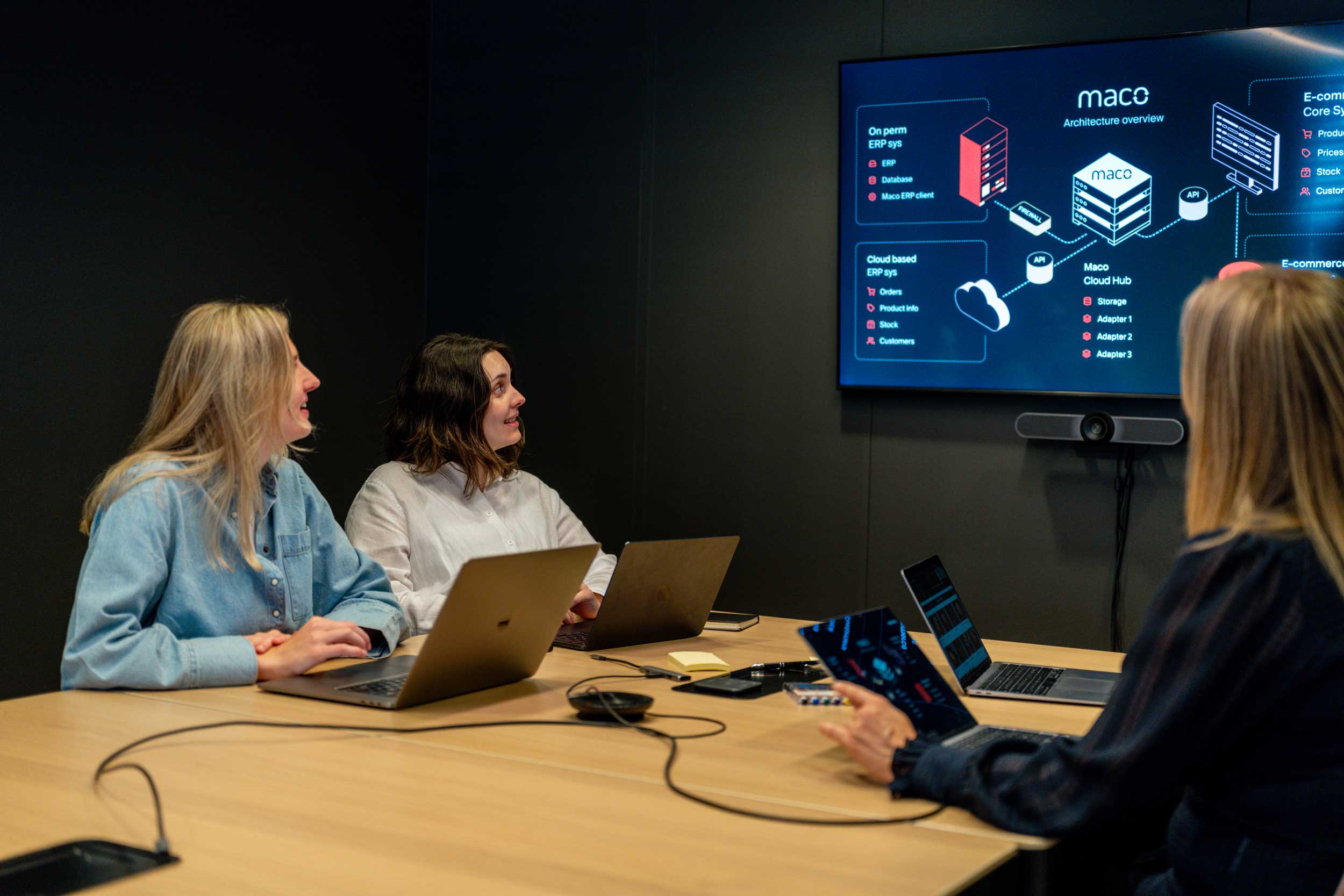
Are you entering orders manually? Does the stock level online not match what is on the shelf? Then it is time to get your systems talking to each other. We build integrations that connect your online store to ERP, accounting, POS, PIM and logistics, tailored to how you actually work, whether you sell to businesses, consumers or both.
We connect your online store to ERP, accounting, POS and logistics




What is synchronised between your online store and ERP?
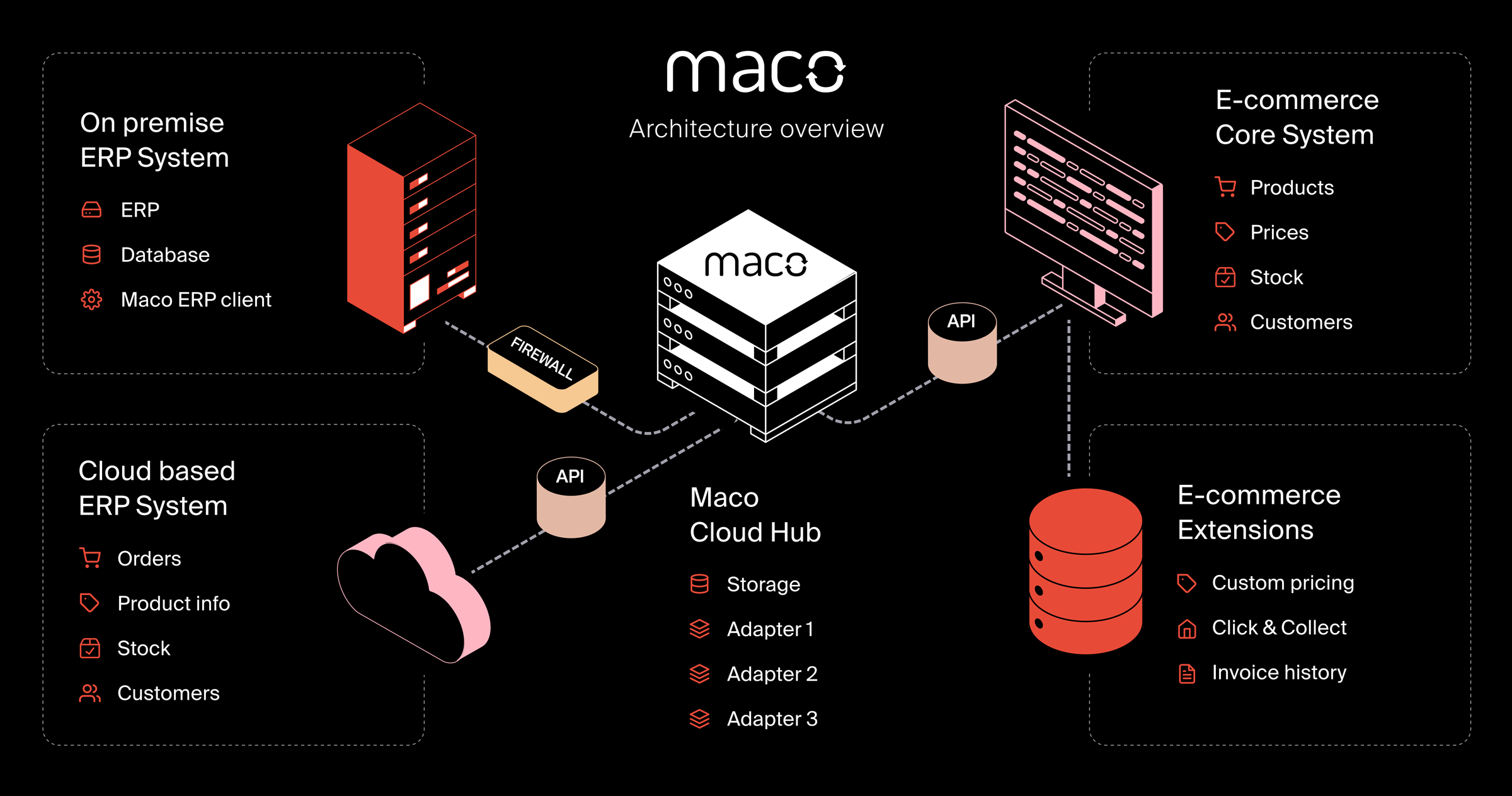
Most integrations start with the core functions below. Extensions such as special prices and campaigns, click and collect, multiple warehouses and refunds can be added when you need them.
| Data | Direction | What it means for you |
|---|---|---|
| Products and prices | ERP to online store | New products, prices and product groups are published without manual work |
| Stock levels | ERP to online store | Customers see accurate stock, even across multiple warehouses and locations |
| Orders | Online store to ERP | Orders go straight into the ERP, ready for picking and invoicing |
| Customers and terms | Between the systems | Correct customer prices and payment terms, especially important in B2B |
| Invoice and order history | ERP to online store | Customers find previous orders and invoices themselves, right in the online store |
Our advice: Start with the core functions, evaluate after a few months and expand where it adds value. That gives you faster results and better control of costs.
How an integration project works
- Mapping. We review your systems and processes, and agree on which data should be transferred, how often and how errors should be handled.
- Setup. We connect your online store to the ERP through our integration engine and set up the core functions.
- Testing. Orders, stock and prices are tested before you go live, so your sales never stop.
- Operations and further development. We monitor the integration, fix errors and take care of upgrades. New extensions are added when you need them.
Maco Cloud Hub: our own integration engine
Our integrations run through Maco Cloud Hub, an integration engine we have developed ourselves. Cloud-based ERP systems such as Tripletex and Visma.net connect directly via API. On-premise systems connect through a dedicated client behind the firewall.
Because everything runs through one hub, you can switch ERP without rebuilding the integration. That is exactly what Instell did when they moved to Visma.net.
Systems we integrate with
We have ready-made integrations with ERP and accounting systems such as Tripletex, Visma, PowerOffice, Microsoft Dynamics and SAP Business One, POS systems such as PCKasse, Front Systems and ExtendaGo, and NOBB for the building materials industry. Choose your system to see what the integration can do.
Can’t find your system? We also build new integrations. If your ERP has an open API, the path is short. Get in touch and we will work out what it takes.
E-commerce partner for successful brands
-

Automated e-commerce at Crossbutikken
From manual work to automated e-commerce at Crossbutikken.
-

Global hobby and art
WooCommerce online store with over 18,000 products synced with Visma Business.
-

Hillesvåg Ullvarefabrikk
Hillesvåg Ullvarefabrikk has experienced substantial growth in revenue year after year, aided in part by a state-of-the-art online store.
-

Instell
Instell has for many years delivered products and software to the electrical and automation industries.
-

1.2 million SKUs on WooCommerce: enterprise ecommerce for Kellox
How Maksimer helped Kellox run enterprise ecommerce on WooCommerce with 1.2 million SKUs, ERP and PIM integrations, B2B self-service, dealer-specific pricing and bulk product updates at scale.
Frequently asked questions about integrating your online store with ERP
An ERP integration connects your online store to your business system, so products, prices, stock, orders and customer data flow automatically between them. It removes manual entry and reduces errors.
The cost consists of a start-up phase (mapping and setup), an ongoing licence for the integration engine, maintenance and any extensions. The price depends on your system and needs, so you get a concrete quote after the mapping. Most companies earn back the investment in 6 to 18 months.
Yes. We have delivered integrated solutions on all three, including Shopify with Visma for A&C Oslo, WooCommerce with Visma Business for Global Hobby and Litium with Business Central for Creon.
Stock levels and orders are synchronised continuously, so your online store shows up-to-date stock and orders reach the ERP quickly. How often the different data should be updated is agreed during the mapping.
Yes. Because the integration runs through Maco Cloud Hub, we only replace the connection to the ERP. Your online store and the rest of the setup stay as before.
No problem. Cloud-based systems connect via API, while on-premise systems such as Visma Global and Uni Micro connect through a dedicated client behind the firewall.

Would you like more information?
Get in touch with us for a non-binding conversation about how we can assist your company as your e-commerce manager.
Jan-Kristian Reierstad
Business developer